
Selling Property Before Moving to Spain: Capital Gains Tax & Financial Considerations
Selling your property is just one of several financial matters worth considering before becoming tax resident in Spain. The timing of a property sale, investments, pension benefits, savings and other overseas assets can all have implications once you become Spanish tax resident.
In This Guide: Timing Your Property Sale • Spanish Capital Gains Tax • Selling and Moving in the Spain Year • Selling vs Renting • Spanish Tax Residency • Capital Gains Tax Rates • Double Taxation • Other Financial Considerations • Tax vs Financial Advice • Frequently Asked Questions • Planning Your Move

📅 Why the Timing of Your Property Sale Can Matter When Moving to Spain
A property sale and a move to Spain can fall within the same calendar year. If you become Spanish tax resident for that year, the Spanish tax treatment of the gain may also need to be considered. This makes timing an important planning question rather than something to review only after the move has taken place.

Capital Gains Tax in the Country Where the Property Is Located
Before selling, check the tax rules that apply in the country where the property is situated. Even where the property has been your main home, the availability and extent of an exemption can depend on specific conditions.
UK Private Residence Relief When Selling Your Main Home
For example, a UK home, Private Residence Relief can mean that no UK Capital Gains Tax is payable where all of the relevant conditions are met. The rules can differ where, for example, the property has been let, used exclusively for business, or the owner lives abroad. Your individual circumstances should be checked before deciding when to sell or relocate.
Official guidance: GOV.UK – Tax when you sell your home: Private Residence Relief (External Link)
🚚Could Moving to Spain in the Same Year as the Sale Affect Capital Gains Tax?
Potentially, yes. If the sale of an overseas property and your relocation to Spain occur in the same calendar year, you should establish your tax-residence position and obtain advice on how Spain will treat the disposal before assuming that the result in the property’s country will also be the result in Spain.
For some people, separating a property sale and a permanent move into different calendar years may form part of legitimate pre-move planning. However, this should not be treated as a universal solution: the Spanish residence tests, the other country’s rules and any relevant tax treaty should be reviewed for the particular individual.
🔑Sell or Rent Your Property Before Moving to Spain?

📑 Spanish Capital Gains Tax When Selling an Overseas Property
Becoming Spanish tax resident can bring overseas income and gains within the Spanish tax system. A sale that is exempt or treated favourably in another country should not therefore be assumed to be exempt in Spain. The Spanish calculation, any available exemption and any applicable double-taxation relief need to be considered separately.
Reinvestment in Another Main Residence
Spanish tax rules provide an exemption from capital gains tax where the gain arising from the sale of a habitual residence qualifies and the proceeds are reinvested in the acquisition or rehabilitation of another habitual residence, subject to the statutory conditions. The property being sold must have been your habitual residence at the time of sale or at any point during the two years preceding the sale. According to the Spanish Tax Agency, the reinvestment must be completed within a period not exceeding two years, whether the reinvestment takes place before or after the sale of the property. Where less than the total amount obtained from the sale is reinvested, only the corresponding proportion of the capital gain may qualify for exemption.
Main Residence Exemption for People Aged 65 or Over
The Spanish Tax Agency states that capital gains arising from the transfer of a habitual residence by a person over 65 are exempt from Spanish personal income tax. To qualify, it is necessary to have lived in the property continuously for at least three years and sell it no later than two years after it ceased being their habitual residence. No reinvestment is required, but the two year rule is strict and still applies. Determining whether the property qualifies as the taxpayer’s habitual residence should nevertheless be checked for the individual case.
📋 When Do You Become Tax Resident in Spain?
Spanish tax residence is not determined simply by the date on which you obtain a residence card or complete an immigration procedure. Tax residence has its own legal tests, so the facts of your year need to be considered.
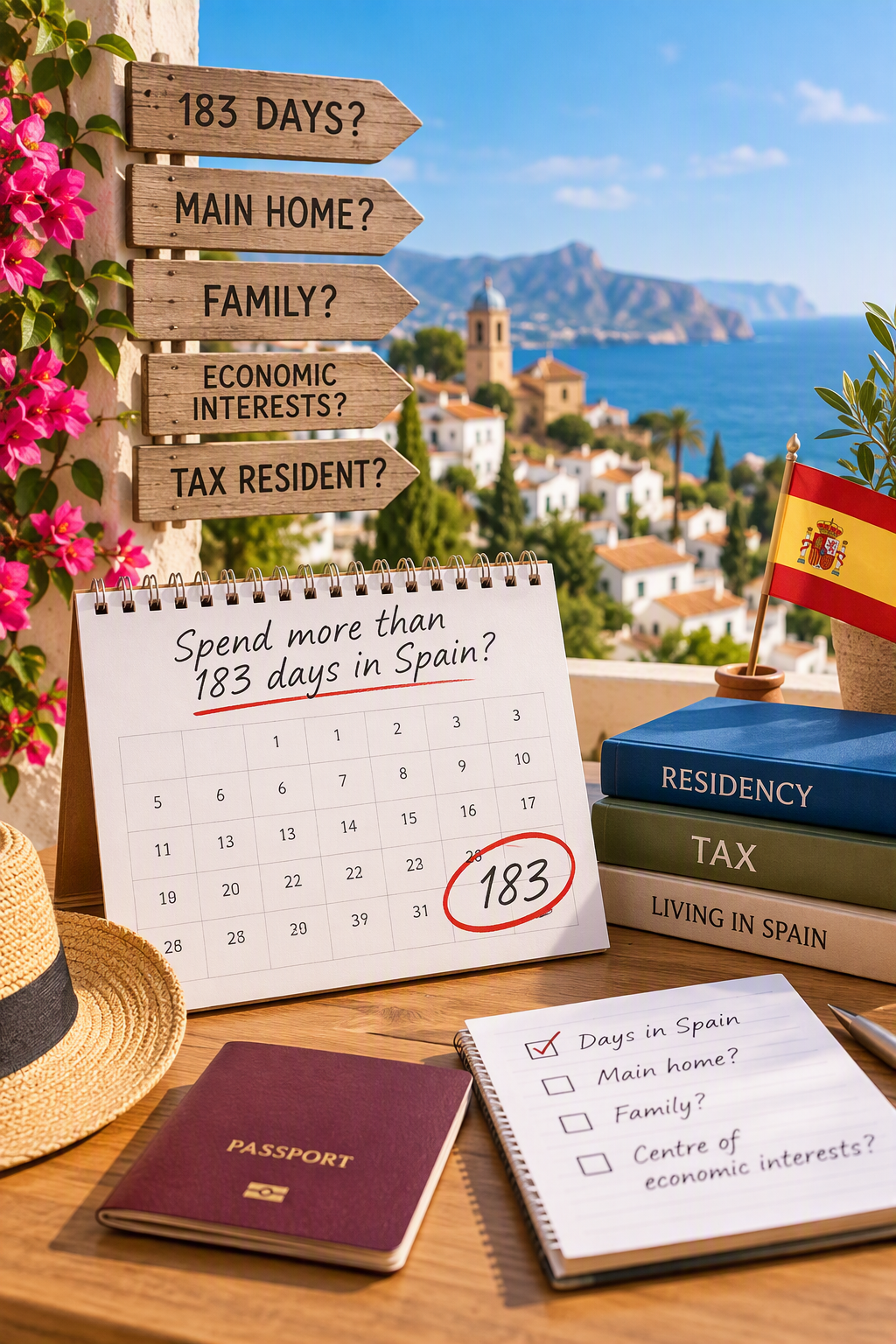
Spain's 183-Day Tax Residency Rule
The Spanish Tax Agency states that an individual is regarded as habitually resident in Spain where they remain in Spanish territory for more than 183 days during the calendar year. Its guidance also explains that sporadic absences can be included in determining the period of presence, unless tax residence in another country is established in the circumstances described by the rules.
Important planning point: 1 July is sometimes treated informally as a rough planning reference, but it is not itself the legal test for Spanish tax residence. Days already spent in Spain during the calendar year, the rules concerning presence and absences, and the other tax-residence tests all need to be considered.
Centre of Activities or Economic Interests
The 183-day test is not the only Spanish domestic test. The Spanish Tax Agency also identifies residence where the principal centre or base of a person’s activities or economic interests is located in Spain, directly or indirectly.
Family and the Presumption of Spanish Tax Residence
Spanish guidance also sets out a rebuttable presumption of habitual residence in Spain where, under the stated criteria, the taxpayer’s spouse from whom they are not legally separated and their dependent minor children habitually reside in Spain. This is another reason not to look at day count in isolation.
📊Capital Gains Tax Rates for Spanish Tax Residents
Capital gains that form part of the Spanish savings tax base are taxed using progressive savings-income rates. Because rates and thresholds can change, they should be checked for the tax year in which the disposal occurs before publication or use in an individual calculation.
| Savings tax base | Rate | |
| Up to €6,000 | 19% | |
| €6,000 to €50,000 | 21% | |
| €50,000 to €200,000 | 23% | |
| €200,000 to €300,000 | 27% | |
| Above €300,000 | 30% |
🌍Double Taxation When You Sell Property Abroad
Capital gains that form part of the Spanish savings tax base are taxed using progressive savings-income rates. Because rates and thresholds can change, they should be checked for the tax year in which the disposal occurs before publication or use in an individual calculation.
Can You Pay Capital Gains Tax in Two Countries?
A property disposal can engage the tax rules of more than one country. Where a Double Taxation Agreement applies, it may affect taxing rights and the relief available. The practical result depends on the treaty, domestic rules and the tax actually payable, so it should be checked for the countries involved.
How Double Taxation Relief May Apply
Do not assume that the difference between two countries’ calculations of the capital gain is automatically the amount payable to Spain. The taxable gain may be calculated differently in each jurisdiction, and any credit or relief for foreign tax is a separate calculation subject to the applicable rules and treaty. A worked example should therefore be prepared or verified by a qualified tax adviser before being presented as applicable to a client.
💼 Other Financial Matters to Consider Before Becoming Spanish Tax Resident

Investments and Savings
Investments that receive favourable tax treatment in your current country may be treated differently once you become Spanish tax resident. Before selling, restructuring or moving investments, consider obtaining advice that takes both jurisdictions into account.
Pensions and Taking Pension Benefits
The timing and form of pension benefits can also have cross-border tax consequences. If you are considering drawing a lump sum or changing pension arrangements around the time of your move, take appropriate advice before acting rather than assuming the treatment will be the same after becoming Spanish tax resident.
Overseas Assets and Modelo 720
Spanish tax residents can have reporting obligations in relation to certain assets held abroad. Modelo 720 is an information return connected with specified categories of overseas assets where the applicable conditions are met. Because the reporting thresholds, categories and subsequent filing rules are technical, obtain advice on whether and when you personally need to file rather than relying only on the fact that funds are held in an overseas account.
Income or gains generated by overseas assets may also need to be considered for the annual Spanish income tax return.
💼 Planning Ahead if You Are Self-Employed or Own a Company
If you intend to continue working after moving to Spain, it is important to consider how the move may affect your business finances and working arrangements as well as your personal tax position.
This is particularly important if you are self-employed, a freelancer or work through your own limited company or other overseas company. The fact that you receive a salary from a company you own does not necessarily mean that your position will be treated in Spain in the same way as it was in your home country.
Spanish Social Security rules take into account factors including your ownership of the company, whether you exercise management and directorial functions and whether you have effective control of the business. Depending on the circumstances, a company owner who works in the business may therefore fall within Spain's rules for self-employed workers rather than being treated in the same way as an ordinary employee.
There may also be wider tax considerations for the company itself when its owner or director moves to Spain and continues managing the business from here. The location from which a company's management and business are effectively directed can be relevant to its Spanish tax position, so this is an area that should be reviewed individually with an appropriately qualified Spanish tax adviser before relocating.
For both freelancers and company owners, it is therefore sensible to understand how operating from Spain could affect your expected tax liabilities, social security contributions, business costs and ultimately how much of your income you retain.
For anyone who is self-employed or owns their own company, we strongly recommend a professional tax review with a Spanish Tax Advisor before relocating to Spain. Understanding the Spanish tax and social security implications in advance can help identify whether changes to your existing arrangements should be considered before you move and become Spanish tax resident.
The Online Autónomo Calculator (external third-party website) may help you assess your income. Help At Hand Spain does not accept any responsibility or liability for this tool, it should be used for indicative purposes only.
🤝Should You Speak to a Tax Adviser or Financial Adviser Before Moving to Spain?
Depending on your circumstances, you may benefit from speaking with a financial adviser or planner, a Spanish tax adviser, or both. Their roles are different but can be complementary.
When and how a Spanish Tax Adviser Can Help
- Spanish tax residence and the application of the domestic residence tests.
- Spanish income tax returns and the treatment of foreign income and gains.
- Capital gains, exemptions and double-taxation issues.
- Overseas asset reporting and other Spanish tax obligations.
- Inheritance, gift and other tax questions that may be relevant to your circumstances and region.
If you intend to continue working after moving to Spain, an adviser can also help you understand:
- Self-employment, including Spanish tax and social security implications.
- Tax and social security considerations when owning or working through your own company, or working for a foreign company abroad
- Potential Spanish tax implications for an overseas company managed from Spain.
When and how a Financial Adviser or Planner Can Help
- Savings, investments and longer-term financial planning.
- Pensions and retirement-income planning.
- Insurance and protection needs.
- How your financial arrangements fit with your move and longer-term objectives, taking account of the adviser’s regulatory permissions and cross-border expertise.
Frequently Asked Questions
Do I have to pay Spanish Capital Gains Tax if I sell my home before moving to Spain?
Is moving to Spain after 1 July enough to avoid becoming Spanish tax resident that year?
If my property sale is exempt from Capital Gains Tax in the UK, is it also exempt in Spain?
Should I speak to a Spanish tax adviser before moving to Spain?
Do I need private health insurance to move to Spain?
What documents do I need for a residency application in Spain?
Do foreign documents need to be translated or apostilled for Spain?
How long does the residency process in Spain usually take?
What do I need to do after arriving in Spain?
What is the difference between an NIE and TIE?
Do you help with Spanish bureaucracy beyond residency?
Can I keep working through my own limited company after moving to Spain?
For this reason, we strongly recommend obtaining advice from a Spanish tax adviser before relocating so that your existing arrangements can be reviewed in the context of Spanish rules.
Could I be considered self-employed in Spain if I own my own company?
This is why it is important not to assume that the employment structure you use in your home country will automatically be treated in the same way after you move to Spain.
Could moving to Spain affect the tax position of my overseas company?
HELP AT HAND SPAIN SERVICES
✅ Planning Your Move to Spain?
The timing of a move to Spain can affect more than your residence application. If you are planning your relocation and would like to understand which professional advice you may need before moving, Help at Hand Spain can help you identify the appropriate next steps and, where suitable, introduce you to a Spanish tax adviser.
For clients moving from the UK who would also benefit from financial planning advice, we can make an introduction to an appropriate professional. If you are relocating from another country, let us know and we will be happy to see whether there is a suitable professional within our wider network.
This article provides general information only and should not be treated as personalised tax, legal or financial advice. Tax outcomes depend on individual facts, the relevant tax year, domestic legislation and, where applicable, the terms of a Double Taxation Agreement.